Night of the Living Traditional PR
Boo!
Did I scare you?
Or has all the AI news scared you enough for a lifetime? I, personally, have a few things I find genuinely terrifying. One thing not on that list is someone calling me and asking: “What’s your favorite scary movie?”
AI is one thing I do find scary! The irony of writing a blog post about AI doesn’t escape me here. I find it terrifying for a more selfish reason: it has taken one of my professional comfort zones, SEO (search engine optimization), and dumped it into a haunted house.
I used to be pretty comfortable with calling myself knowledgeable about SEO. At one point, I helped take a small non-profit from relative obscurity to the top result on Google in about six weeks. I knew what I was doing! I knew what Google wanted, and I knew how to make web pages useful, findable, and competitive.
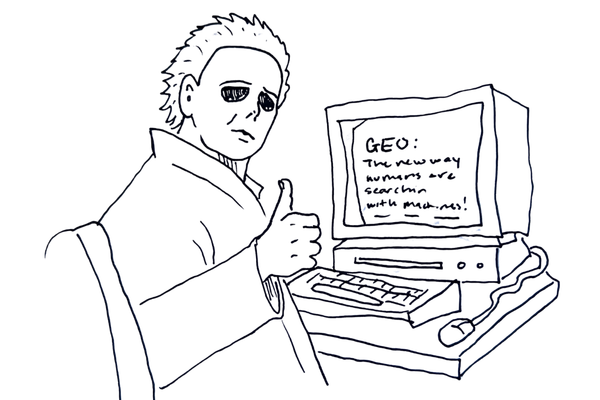
I wouldn’t call SEO dead. Like Michael Myers, it’s still very much in the picture. But AI-powered search has opened up another dimension — cue The Twilight Zone theme. Enter GEO: Generative Engine Optimization, the emerging practice of improving a brand’s visibility in AI-generated answers from tools like ChatGPT, Gemini, and Claude and other spaces that millions of people have moved their traditional searches to. SEO still matters; now we also have to consider how AI systems find, reference, and represent our work.
The rules feel different because we are no longer just trying to rank first when someone Googles something. We’re trying to become one of the sources an AI system encounters, trusts, and potentially cites. But here’s the twist: AI search may actually give organizations another reason to invest in the things human-managed PR has always helped build: useful content, credibility, relationships, and trusted third-party voices.
And that brings me back to something that some folks in 2016 thought we had buried…
Traditional PR is Dead!
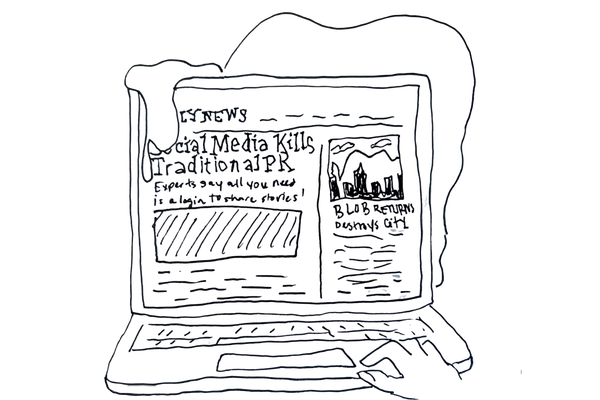
About a decade ago, there were blogs and articles telling us that traditional PR was dead. Perhaps the naysayers were a little hyperbolic. We know, as a strategic consulting and communications firm, that PR has never died; it just absorbed new channels and expanded. Reminiscent of The Blob, if The Blob had planning meetings about whether or not Instagram is the right channel or the right timing for a client and their brand.
Around that time, I was working pretty deeply in the event and catering world. I dabbled in SEO and social media marketing, mostly making sure my workplaces maintained a strong presence on Google and kept their rankings high on wedding websites. Social media was changing the game. Suddenly, you didn’t necessarily need to earn access to an audience; your audience was right there!
Why spend time pitching 800 words to a local magazine when you could post the thing on Facebook yourself? Why wait for a journalist to decide your announcement made interesting news when you could publish it directly to thousands? It was exciting! But also only partially true.
Earned media still mattered, as did being covered by a credible publication. You needed to build your audience. Your organization, research, expertise, or story still needed external voices showing you that it was worth talking about. They just became less central during a period when everyone was excited about direct-to-audience distribution.
There was even a 2014 PR News article with the prophetic headline, “Embracing Social Media Shouldn’t Come at the Expense of Traditional PR.” The piece argued that while the communications landscape was changing, the fundamentals of good communication had not disappeared.
Social Media Changed the Distribution Model
Before social media, the traditional communications path looked something like:
Organization → PR professional → journalist → publication → audience
Then social media introduced something much more direct:
Organization → platform → audience
And for a while, that felt like the future.
Now GEO introduces something closer to:
Organization → web ecosystem → AI/search system → audience
Like any scary movie, that middle part is important! You need the context to survive this haunt.
Earned and owned authority have to work together
The AI system isn’t just looking at what you said about yourself. It’s looking across the web. Your website and content matter, as does your social presence. But so can journalism, research, reviews, expert commentary, university pages, industry publications, and other places where people can talk about you when you’re not in the room.
That means owned and earned content have to work together.
Say, for example, one of our clients publishes an excellent report about career literacy. The report itself provided owned authority. Now, if Inside Higher Ed, a media platform for higher education research, shares that report, that’s considered earned authority from a trusted publication.
When researchers see that and cite it, universities reference it, and journalists quote and discuss its ideas, you’ve built something more than a single piece of content, but an ecosystem of authority. All built on traditional PR, and crawled by AI systems across many signals online.
The Machines Are Reading the Room
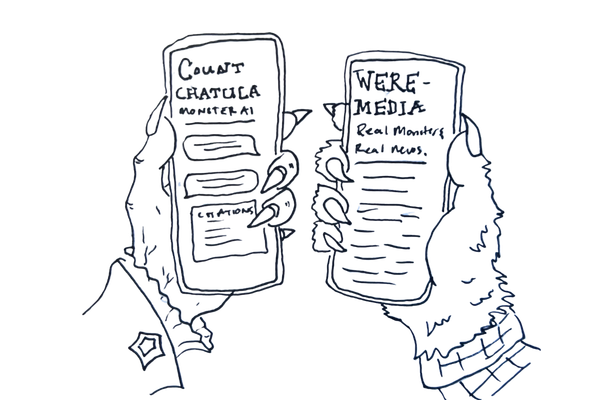
A recent Forbes Business Council article, “Why PR Is Now Your Most Powerful AI Strategy,” points to research showing that earned media makes up a substantial share of AI citations. A 2026 research synthesis drawing on multiple studies puts the figure at 84% across its aggregated dataset, with brand-owned and paid media making up less than 16%.
That does not mean every AI engine cites earned media 84% of the time. The mix varies considerably by platform, industry, and query. Meltwater’s 2026 research, for example, has found meaningful shifts in the source mix from month to month.
But the larger point is pretty hard to miss: AI search is looking beyond what organizations publish about themselves substantially, if not mostly.
That makes PR suddenly look a lot less like an old-school practice that just happened to survive the rise of social media, and a lot more like a fundamental piece of the new search ecosystem.
Plot Twist!
I spent years telling PR people they need to learn SEO; now SEO people (me) are learning that PR has been building the bulk of the signals that AI systems care about the most all along! The call was coming from inside the house!
Because the things PR has always been good at: credibility, relationships, getting people to talk about your work – are suddenly very relevant to how organizations are showing up in AI-generated answers.
What this means for your organization
Don’t let your content become a ghost story!
- Publish useful research, insights, and answers that demonstrate your expertise.
- Build credibility beyond your own channels through relevant coverage and opportunities for others to reference your work.
- Connect the pieces so your website, earned coverage, and social content support one another.
AI tools can still make parts of this work faster. But there is a pretty important distinction between producing communications and building authority for organizational GEO. As Gini Dietrich of Spin Sucks writes in her recent piece on AI visibility and trust, “There is no easy button. No AI tool will do that for you.”
The underlying work of building visibility is familiar: create something worth sharing, earn credibility beyond your own channels, and connect those pieces into a larger ecosystem. And the next steps? Someone has to know what makes a story interesting. They need to know which journalist will roll their eyes at a subject line. Someone has to know the publication you want to pitch to hasn’t covered a story like this in over five years. They need to have relationships, and they have to pitch to real human beings. They need to know not to send that pitch on a Friday night (especially not Friday the 13th). And someone has to look at that earned coverage and think, “Okay, what channels can we share this on next?”
That is where your friendly neighborhood strategic communications team comes in. Through Mazur & Co.’s “Communicate” service line, we’re still doing the very human work of figuring out what is worth saying, who might care, where it belongs, and how to get it there. No silver bullets, no secret formula, no season-of-the-witch marketing trick, just good PR.
Now there is just another audience we have to think about in addition to the human one: the machines.
Now that we’ve survived this haunting
And the PR landscape feels less scary; you can get your October scares somewhere else. A quick disclaimer: This is my personal list of favorites, not a list of movie recommendations from Mazur & Co. Any questionable taste is mine alone:
House (1977)
Night of the Demon (1957)
The Lost Boys (1987)
Bram Stoker’s Dracula (1992)
House on Haunted Hill (1959)
Halloween III: Season of the Witch (1982)
Attack the Block (2011)
The Thing (1982)
Muppets Haunted Mansion (2021)
Over the Garden Wall (Miniseries) (2014)

Halloween, 1993. That’s me in the back, practicing my jump-scares.